
What is ADCA
ADCA stands for Advanced Diploma in Computer Applications.
It’s a diploma-level vocational/skill-oriented course designed to teach practical and theoretical computer/application skills — from basic computer literacy to programming, software, office automation, web design, etc.
The aim is to equip students — often beginners — for jobs in IT sector, office work, data-entry, accounting, web design, support roles, etc.
Typical Eligibility, Duration & Fees

Eligibility
Minimum 10th pass (some institutes prefer 12th pass)
Basic knowledge of computers is helpful (not mandatory)
Open to students, job seekers, and working professionals
What You Learn (Syllabus / Course Modules)
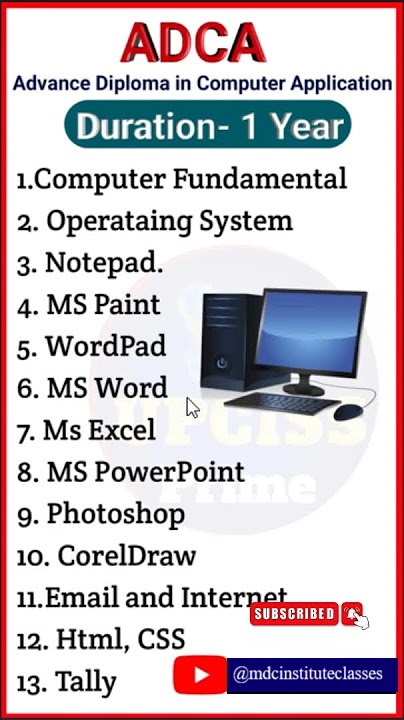
Though syllabus may vary across institutes, typical ADCA courses cover a broad range of computer and IT-related topics. Common modules/topics include:
Computer fundamentals — hardware vs software, components, generations, input/output/storage devices, basics of OS. Operating Systems & Basic Software — MS-DOS, Windows, file management, system basics.
Office Automation / Productivity Tools — MS Office (Word, Excel, PowerPoint, Access), email, internet, basic email/internet tasks.
Accounting / Finance Tools — e.g. basic accounting, use of accounting software like Tally / Tally ERP.
Programming & Database — languages like C, C++; database management, sometimes basics of web development (HTML, CSS, JS), web design.
Graphics / Design / Multimedia (optional or in some institutes) — software like Photoshop, CorelDraw; basic graphic design / DTP / multimedia concepts.
Internet, Networking & Web — internet basics, email, web browsing, sometimes web design, HTML/CSS/JS.
Soft Skills / Communication / Job-readiness — some institutes add modules on communication skills, interview preparation, personality development.
Depending on the institute, there may be lab/practical sessions, project work, and practical assignments.
Who Is It For / What Are Potential Outcomes
ADCA is well-suited for:
Students who have passed 10th / 12th and want to build computer skills.
Individuals seeking a basic-to-intermediate grounding in computer applications without committing to a full-fledged degree.
People aiming for job roles such as data entry operator, office assistant, administrative support, junior developer/ programmer (depending on programming exposure), accounting support (with Tally), web designer, office automation, etc.
Those wanting to improve digital literacy — helpful for modern offices, government/private jobs, freelancing, etc.
Some estimate typical salaries for freshers after ADCA around ₹2.5-3.5 lakhs per annum (though this heavily depends on job, skills, and location).
Pros & Limitations: What to Check Before Enrolling

Pros:
Gives a broad skill-set: from basics to programming, office tools, web design.
Relatively short duration vs. degree courses — you can finish in ~6 months to 1 year.
Affordable (compared to full-time undergraduate courses).
Good for entry-level office/IT support roles, data-entry, admin, basic programming or web-design jobs.
Even with no prior computer background, you can start from basics (many ADCA courses assume little to no prior knowledge). Limitations / What to check:
It’s not equivalent to a full computer science degree — depth in programming, algorithms, advanced software engineering, etc. will be limited.
Quality varies widely: syllabus, labs, real hands-on practice, certificate recognition — it depends heavily on the institute.
For high-end IT roles (software dev, engineering, data science) further study or degree may be needed.
Job prospects and salary can be modest at entry level.
Eligibility
- Minimum 10th pass (some institutes prefer 12th pass)
- Basic knowledge of computers is helpful (not mandatory)
- Open to students, job seekers, and working professionals
⏱ Duration
- 6 months to 12 months
- Depends on:
- Institute
- Part-time or full-time mode
- Some institutes also offer fast-track courses (3–6 months)
💰 Fees
- Typically ranges between ₹9950 to ₹25,000
- Government or authorized institutes: lower fees
- Private institutes: higher fees, depending on facilities and certification
🏫 Mode of Study
- Classroom / Offline
- Online

